
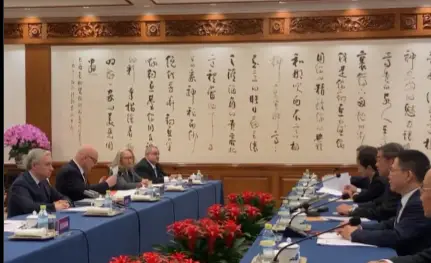
A joint statement dated 3 April 2026 from Beijing was released and it announces the launch of the Canada-China Financial Working Group (FWG), it’s not a binding trade deal, investment treaty, or loan agreement.
It is a formal diplomatic communiqué that:
- Formalizes a permanent bilateral channel for senior officials (Canadian side: Finance Minister François-Philippe Champagne + Bank of Canada, OSFI, Department of Finance; Chinese side: PBoC Governor Pan Gongsheng + NFRA, CSRC, SAFE).
- Focuses on technical discussions about monetary policy, financial stability, regulation, anti-money laundering (AML), cross-border capital flows, and global financial governance.
- Commits both sides to meet again later in 2026.
In short, this is an institutional dialogue mechanism, similar to existing Canada-China working groups on trade or agriculture. It lowers barriers to information-sharing and regulatory cooperation but creates no new market access, tariffs, or financial commitments.
Pros and Cons of this Canada-China Financial Working Group
I have broken the analysis into the three dimensions you asked for. These are based on the actual content of the statement, publicly known characteristics of both countries’ financial systems, and established patterns in Canada-China relations.
1. Financial Perspective
Pros
- Improved early warning on global shocks (e.g., interest-rate divergence, currency volatility). Regular technical talks between the Bank of Canada and PBoC can help manage spillover effects on the Canadian dollar and bond markets.
- Better cross-border capital-flow management and AML cooperation. This could reduce compliance costs for Canadian banks operating in China and make it easier to track illicit finance.
- Potential for incremental market access. Deeper regulator-to-regulator contact often precedes modest easing of licensing or investment rules for financial services firms.
- Two-way investment promotion. Canadian pension funds and insurers could gain clearer signals on Chinese regulatory changes; Chinese institutions could invest more predictably in Canadian debt or infrastructure.
Cons
- Asymmetric openness. China maintains strict capital controls, state-directed lending, and an opaque shadow-banking sector. Canadian firms still face significant barriers in China, while Chinese state-linked entities gain easier entry into Canada’s open market.
- Exposure to Chinese systemic risks. China’s property sector, local-government debt, and high leverage are ongoing concerns; closer dialogue does not eliminate the risk that a Chinese credit event could transmit volatility to Canadian markets via trade or investment channels.
- Regulatory arbitrage risk. Differing standards on fintech, ESG disclosure, and data localization could create loopholes that Canadian regulators later have to close at extra cost.
- Opportunity cost. Time and resources spent on this group could be diverted from deeper integration with more open, rules-based partners (US, EU, UK, CPTPP countries).
2. Geopolitical Perspective
Pros
- Diversification signal. Canada’s trade is heavily concentrated with the US (~75 %). A structured financial channel with China reduces single-partner dependence and gives Ottawa another lever in economic diplomacy.
- Continuity with the January 2026 Economic and Trade Cooperation Roadmap. This keeps the bilateral relationship “warm enough” to protect existing Canadian exports (agriculture, resources, education) without requiring new concessions.
- Engagement in global governance. Both countries sit on the IMF, G20, and Financial Stability Board; coordinated positions on issues like debt restructuring or CBDC standards can amplify Canada’s voice in multilateral forums.
Cons
- Timing amid US-China strategic competition. Washington increasingly views financial-sector engagement with China as a vector for technology transfer and influence. Canada risks being perceived as “decoupling-lite” or hedging, which can complicate NORAD, defence procurement, and critical-minerals policy with the US.
- Precedent for economic coercion. China has previously used trade (canola, pork, seafood) to punish Canada over political disputes (Huawei, Meng Wanzhou, human rights). A financial working group does not eliminate that leverage; it may even give Beijing new points of contact inside Canadian institutions.
- Signalling to allies. Australia, the UK, Japan, and the EU are tightening financial scrutiny of Chinese entities. Canada moving in the opposite direction could erode trust within Five Eyes and G7 finance tracks.
3. Security Perspective
Pros
- Stronger AML and counter-illicit-finance tools. Joint work on cross-border flows and sanctions implementation can help Canada disrupt money laundering linked to fentanyl precursors, human smuggling, or sanctioned Russian/Chinese entities.
- Reduced miscalculation risk. Regular senior-official contact lowers the chance of accidental escalation in financial crises (e.g., sudden capital controls or SWIFT-style exclusions).
Cons
- Espionage and influence vectors. Finance ministries, central banks, and regulators are high-value intelligence targets. Closer interaction increases opportunities for Chinese state actors to collect sensitive economic intelligence, recruit insiders, or conduct elite-capture operations.
- Critical infrastructure risk. The financial sector is designated critical infrastructure in Canada. Deeper integration with institutions ultimately controlled by the Chinese Communist Party raises long-term concerns about data localization, supply-chain compromise (fintech vendors), and potential for disruption in a crisis.
- Conflict with existing security frameworks. Canada’s Investment Canada Act, National Security Review Guidelines, and CSIS warnings already flag Chinese state-linked financial activity. A new working group creates parallel channels that could complicate or bypass those reviews.
- Alignment perception. Public optics matter: signing a high-profile document with the PBoC (a CCP-controlled institution) shortly after a prime-ministerial visit can be portrayed domestically and internationally as closer strategic alignment with an authoritarian regime, potentially affecting intelligence-sharing trust with Five Eyes partners.
Bottom line
This is a low-commitment, reversible dialogue mechanism — not a “sell-out” or major strategic realignment. The financial upsides are mostly incremental and technical; the geopolitical and security downsides are larger because they sit against the backdrop of US-China rivalry, past Chinese economic coercion against Canada, and ongoing intelligence concerns.
Whether the pros outweigh the cons depends on what Ottawa actually extracts from future meetings (tangible market access, credible AML cooperation) versus what Beijing gains (legitimacy, access points inside Canada’s financial regulatory system). If the group remains purely technical and delivers measurable stability benefits without compromising national-security red lines, it can be net-positive. If it becomes a vehicle for political signalling or influence operations, the risks will dominate.