
The Rise of the Socratic FOI
Why the real power of an FOI lies not in the documents you receive, but in the questions you ask in public.
| Follow Nick Walsh on Substack, Jul 10 |
The Freedom of Information system is a trap. It is designed to look like accountability while functioning as a containment mechanism.
Yesterday, I was discussing this with a close friend and AI expert who is one of the most successful, relentless FOI authors in British Columbia. He has mastered the mechanics of the FOI. But as I reviewed the trajectory of his requests, a harsh reality became impossible to ignore: the only people who ever know what was asked, or what was redacted, are the citizen who wrote it and the bureaucrat tasked with burying it.
We live in an era where our provincial and federal governments are increasingly disconnected from the citizens who ostensibly elect them. When you submit a traditional FOI into this system, what happens?
It is rejected outright. It is obfuscated behind page-count fees. It is kicked down the road through endless administrative delays. The bureaucrat processes the request in the dark, and the public learns nothing.
This is by design. Former CIA profiler Chase Hughes recently conducted a seminar on “playing the game.” His central thesis when facing down a massive entity—an entrenched organization, a hostile corporation, or a government—is stark: Anytime you go against an entity and you play their game, or you agree to answer their questions, or follow their processes on their terms, you are immediately playing a rigged game. And you are going to lose. The only way to win is to stop playing their game and change the rules.
The traditional FOI process is the ultimate rigged game. The government sets the boundaries, the timelines, the arbitrary fee structures, and the redaction markers.
This brings us to our Kobayashi Maru moment.

In the Star Trek universe, the Kobayashi Maru is a famous no-win training simulation used to test Starfleet cadets.
A civilian freighter sends out a distress call from inside the Klingon Neutral Zone. If the cadet goes in to rescue the ship, Klingon warships attack and the cadet’s ship is destroyed.
If the cadet refuses to enter the Neutral Zone to avoid a fight, the civilian crew dies. There is no programmed way to win. The purpose of the test is simply to see how a captain handles inevitable defeat.
Submitting a standard FOI to a modern government agency is exactly this scenario. If you don’t submit it, you get no information. If you do submit it, you get buried in a bureaucratic maze, and the public still gets no information. The simulation is rigged for you to fail.
But James T. Kirk became legendary because he refused to accept the premise. Before taking the test, Kirk reprogrammed the simulation. He changed the software so that he could defeat the Klingons and rescue the ship. **He changed the rules.**
If we want to extract the truth from our government, we have to reprogram the simulation. We have to stop playing the bureaucrat’s game.
On the surface, the goal of an FOI is to extract data about a specific circumstance, event, or questionable government project. But we have to ask ourselves: what are we *actually* trying to achieve?
If we were wildly successful under the old rules, we would get a package of documents that we could hand to the public and say, “Look what they’ve done.”
But the system rarely lets us get that package. And so, we must change the paradigm.
I am old enough to remember the political lessons of Joseph McCarthy, who once openly explained his strategy: *”I can ask my opponent a question and it doesn’t have to be about the truth. It just has to plant doubt in the minds of the public.”*
Given the state of our captured media and the algorithmic nature of social media today, I have come to a conclusion that will upset the purists, but one that is absolutely necessary for our times: **There is oftentimes better productivity and more political effect from the optics of the question than there is in the actual receipt of the FOI documents.**
This realization is what I call the **Socratic FOI**.
I was formulating this concept in my sleep, and when I woke up, I found an article that perfectly articulated the underlying mechanical philosophy of what I am talking about—though it applied it to a different context.
The article broke down the anatomy of a “weaponized question.” It noted that before the serpent openly contradicted God in the Garden of Eden, he didn’t make a statement; he asked a question. *”Did God actually say…?”*
The article pointed out that this tactic distorts reality, puts the target on the defensive, and invites the audience to reconsider what they previously believed. It noted that a question can carry an accusation while allowing the accuser to deny responsibility for it. When challenged, the questioner simply retreats: *“I never said that. I was only wondering.”*
Now, applying this to a murder trial or attacking grieving widows, as the article described, is a grotesque inversion of morality. “Just asking questions” to destroy innocent private citizens is wicked. It bears rotten fruit.
But what happens when we take this exact mechanical framework and turn it against an unaccountable, opaque government bureaucracy?
Suddenly, it is no longer a sin. It becomes a vital tool of democratic warfare.
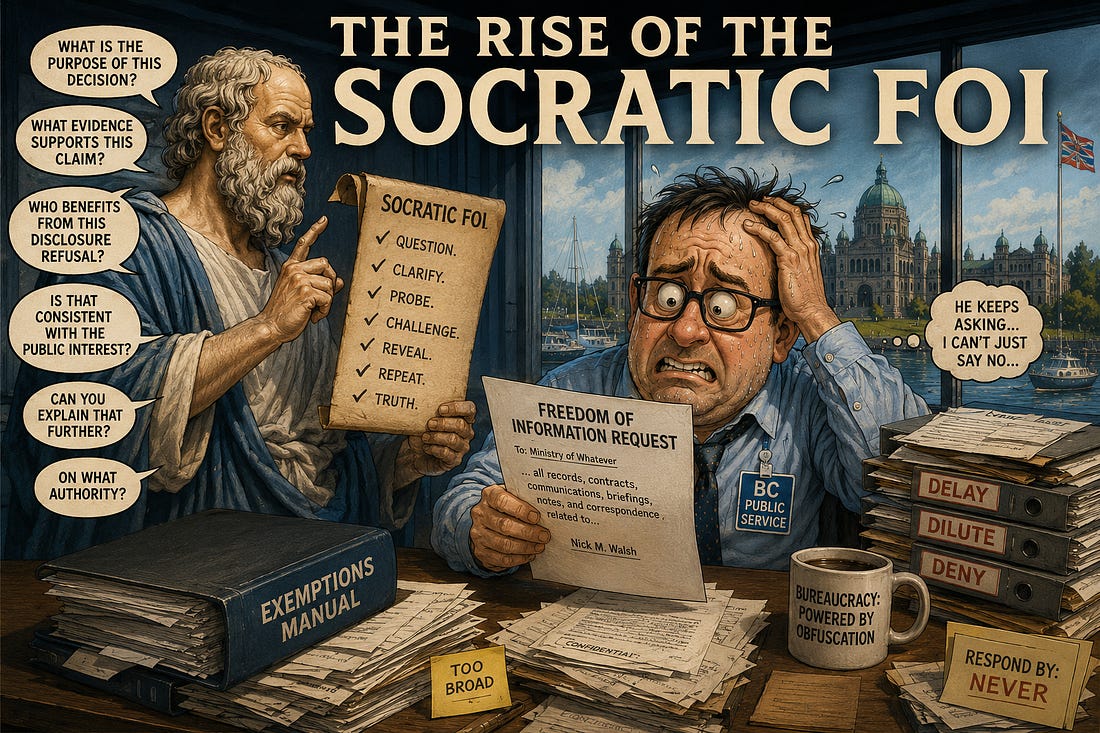
The **Socratic FOI** recognizes that in a rigged system, the question itself is the payload. The traditional FOI asks the bureaucrat for the truth. The Socratic FOI uses the question to plant a seed of doubt in the minds of the public about the government’s official narrative. It is how we reprogram the Kobayashi Maru.
When you submit an FOI the traditional way, the government controls the environment. They control the timeline, the redactions, and the narrative. But when you execute a Socratic FOI, you bypass the bureaucrat entirely and speak directly to the court of public opinion.
How does it work?
You draft the FOI request. But instead of quietly mailing it into the black hole of a government ministry, you publish it. You broadcast the exact questions you are asking the government. You highlight the specific documents you are demanding. You explain *why* you are asking for them, and what you suspect might be hidden in them. You force the question into the public square before the government has time to formulate its excuse.
The article I read this morning noted that social media “rewards certainty before the facts are complete and spectacle before context.” It lamented that “a clipped answer becomes a bombshell” and “an inconsistency becomes evidence that everyone involved is lying.”
If we are being honest with ourselves, this is precisely the environment we must weaponize to hold the state accountable.
If the government is hiding the truth about a massive public expenditure, a health policy failure, or a scandal, we cannot wait three years for a heavily redacted PDF to drop on a Friday afternoon. **We must make the *refusal to answer* the scandal.**
By launching a Socratic FOI, you force the government into a corner. They now have to answer to the public, not just to an internal records officer. If they reject the Socratic FOI, you don’t walk away dejected. You use their rejection as proof of the very thing you suspected. You say to the public: *”I asked them for X. Here is exactly what I asked. They refused to give it to you. What are they hiding?”*
The effect is transformative. Instead of the FOI being a private transaction that ends in administrative failure, the Socratic FOI becomes a public spectacle that achieves its primary goal before the ink is even dry on the bureaucrat’s rejection letter.
The goal was never just the data; the goal was to make everybody know what we are asking, and more importantly, what we suspect is going on.
A question can be a weapon. The article I read this morning warned against this, arguing that we must examine the “fruit” of such tactics. So let us examine the fruit of the Socratic FOI.
Does it produce justice? Yes, by forcing sunlight onto a system that operates in the dark.
Does it produce truth? Yes, by making the government’s evasion of the truth the story.
Does it produce faction and cruelty against the innocent? No. It directs suspicion exactly where it belongs: toward the state that claims to serve us but refuses to show its work.
The traditional FOI system assumes the government is fundamentally honest but just needs help finding the right file.
The Socratic FOI operates on the sober reality that the government is actively managing its own public relations and hiding its failures.
We do not have the power to subpoena the government. We do not have the millions of dollars required to fight them in court when they illegally redact documents. But we do have a platform, and we have the power to ask questions.
The serpent asked a question to deceive the innocent. We will ask questions to expose the guilty. If the government wants to clear its name, let them release the documents unredacted and in real-time. Until they do, the question mark is our most powerful weapon.
Publish your FOIs. Make them public. Make the bureaucrats answer to the crowd. Welcome to the era of the Socratic FOI.